www.isrg.us
  • IRENE School of Rhythmic Gymnastics - 844-TRY-ISRG (879-4774)

    Coaching by Masters of Sports of Russia in Rhythmic Gymnastics.

  • IRENE School of Rhythmic Gymnastics - 844-TRY-ISRG (879-4774)

    Coaching by Masters of Sports of Russia in Rhythmic Gymnastics.

  • IRENE School of Rhythmic Gymnastics - 844-TRY-ISRG (879-4774)

    Coaching by Masters of Sports of Russia in Rhythmic Gymnastics.

Showing posts with label Ballet Orange County CA. Show all posts

Thursday, October 23, 2014

S. Korea first gold in rhythmic gymnastics


Son Yeon-jae gives S. Korea first gold in rhythmic gymnastics

October 2, 2014
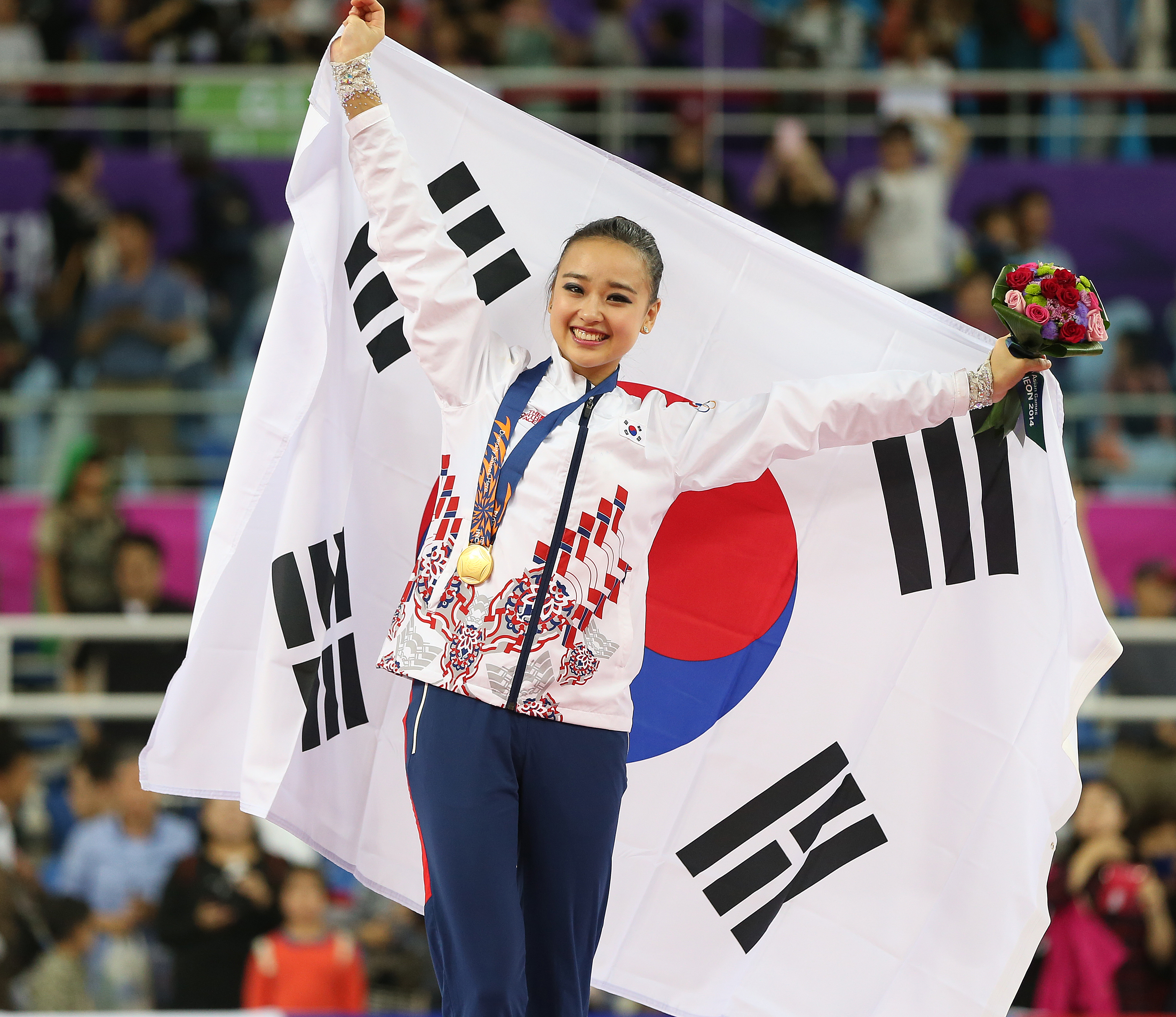

Son Yeon-jae celebrates after winning her first Asian Games gold medal. (Yonhap)
By Kwon Ji-youn
INCHEON ― South Korea’s rhythmic gymnast Son Yeon-jae wrote history, Thursday, claiming her country’s first-ever Asiad gold in the individual all-around event.
The 20-year-old finished first with an aggregated score of 71.699 to win at the Namdong Gymnasium in Incheon, which was packed with Korean fans to support the celebrity-status gymnast.
She expressed satisfaction with her performance and thanked her fans.
“I think I did well. I did my best,” she said. “I thought I would not feel any different, but when the national flag was raised with the anthem playing, I remembered all the hard training I went through.”
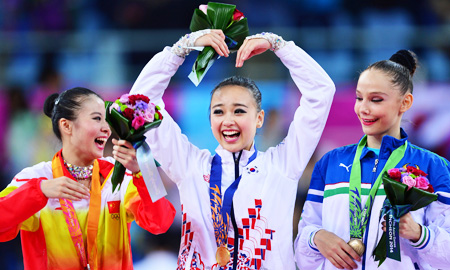
Son Yeon-jae, center, makes a heart-shape with her arms after winning South Korea's first-ever Asiad gold in the individual all-around event at the Namdong Gymnasium in Incheon, Thursday. China's Deng Senyue, left, won the silver, while Anastasiya Serdyukova of Uzbekistan settled for bronze. (Korea Times photo by Shim Hyun-chul)
Son Yeon-jae, center, makes a heart-shape with her arms after winning South Korea’s first-ever Asiad gold in the individual all-around event at the Namdong Gymnasium in Incheon, Thursday. China’s Deng Senyue, left, won the silver, while Anastasiya Serdyukova of Uzbekistan settled for bronze. (Korea Times photo by Shim Hyun-chul)
In response to their cheering, Son staged almost flawless performances, outperforming rival Deng Senyue of China by 1.367 points, and shed tears as the Korean national anthem echoed through an almost-full stadium.
Son, who performed 7th, received scores exceeding the 18-point mark in three of the four disciplines.
She qualified for the finals in first place with 53.882 points, while her Chinese rival qualified second with 52.883 points. In the qualifier, the lowest score is dropped.
Deng maintained second rank in all disciplines for her silver-medal finish with 70.332 points, while Anastasiya Serdyukova of Uzbekistan claimed the bronze medal with 68.349 points.
Son broke ground with a striking performance in the clubs discipline, her most difficult program, earning 9.000 in difficulty and 9.100 in execution for a score of 18.100 with no penalties. This surpassed the 18.016 she had received in the qualifying round.
She then staged an excellent faultless performance in the ribbon event to earn 8.950 in difficulty and 9.133 in execution for 18.083 points, maintaining the lead after two events. She left the arena to enormous applause.
Son then proved dominant once more with a lively hoop performance, which received a difficulty score of 9.050 and an execution score of 9.166 for a total of 18.216.
But in her last event, Son missed the ball after a throw, and picked up 8.600 difficulty points and 8.700 execution points for a combined score of 17.300. Deng also fumbled the ball to earn 17.400, but had scored lower in the ribbon and hoop, earning 17.483 and 17.583 respectively. In the clubs, she collected 17.866 points.
Son’s fourth-place finish at the 2014 World Rhythmic Gymnastics Championships in Izmir, Turkey, was also affected by a mistake she made in the ball section. In Izmir, Son aggregated 70.933 to outperform Deng by just 1.167 points. She also became the first Asian to medal at the championships with a bronze in the hoop event.
Another South Korean gymnast Gim Yun-hee finished 9th with 63.666 points, bettering her 22nd-place finish at Guangzhou by 13 spots. Crowds cheered deafeningly as the 23-year-old walked off the stage after an impressive hoop performance to Arirang, a Korean folk song, which earned her 16.300 points. Gim also reaped 16.450 in the ball, 15.516 in the clubs and 15.400 in the ribbon.
Serdyukova and Djamila Rakhmatova both of Uzbekistan put on a close fight for third, with Serdyukova coming out the winner to bag bronze. Rakhmatova finished fourth with 67.799 points.
With her victory, Son avenged her bronze-medal finish at the 2010 Guangzhou Asiad, ending the countries worries of no big star athletes making a memorable impression in the event at home. Swimmer Park Tae-hwan, gymnast Yang Hak-seon and sharpshooter Jin Jong-oh failed to win individual golds at Incheon. Park was spotted in the audience at Son’s competition, Thursday.

Friday, August 29, 2014

Russians dance to double gold in rhythmic gymnastics

NANJING 2014

OPTIONS

Russians dance to double gold in rhythmic gymnastics

Russians dance to double gold in rhythmic gymnastics
©Xinhua (2)
27/08/2014
Russia dominated the rhythmic gymnastics finals at Nanjing 2014 on 26 August, winning both gold medals on offer.
A graceful display saw Irina Annenkova (RUS) score 58.575 points to take the gold medal in the individual all-around final.
And despite leading the event from the first round, Annenkova revealed she had not been tempted to play it safe at any point.
Irina Annenkova won gold in the rhythmic gymnastics individual all-around 
“On the contrary; I wanted to do even more, because I wanted to increase the gap between me and the other competitors,” Annenkova said.
With a score of 56.950, Maryia Trubach (BLR) claimed silver, followed closely by Laura Zeng (USA) with 56.750 for bronze.
The group all-around final was contested on hoops and clubs, with Russia winning gold after scoring 29.550. Bulgaria took silver with 27.050 and Kazakhstan picked up bronze with 25.050.

Wednesday, August 13, 2014

Rhythmic Gymnastics History.


Daughter of Russia

Rhythmic Gymnastics as a competitive discipline evolved toward the 1920s in the USSR. It quickly developed in a variety of schools, and its first high-level national event was held in 1942.
In the past, Women’s Artistic Gymnastics at the Olympics included some exercises with apparatus. For example, in 1928, in Amsterdam, a team of 10 gymnasts competed on vault or rings and with group-free exercises with hand apparatus (1- NED; 2-ITA; 3- GBR). In Berlin 1936, teams with 8 gymnasts competed on vault, parallel bars, balance beam and group free exercise with hand apparatus (called optional team drills; 1-GER; 2-CZE; 3-HUN). Rhythmic group exercises with hand apparatus have been used in team competition by women in the 1952 and 1956 Olympic Games and at the same time it was also a separate event. The members of the group were obliged to compete in apparatus (vaulting, uneven bars, beam and floor). 
In 1956, the FIG decided to exclude group exercises with hand apparatus from international competitions.
Consequently, Rhythmic would have to wait until the late 1950s for true recognition, and it was through the persuasive commitment and dedication of two FIG women, Andreina Gotta (ITA) and Berthe Villancher(FRA), that the discipline came into its own in 1961. After Men’s and Women’s Artistic Gymnastics, Rhythmic became the third official FIG competitive discipline.
The premiere World Championships in Individuals were held in Budapest (HUN) in 1963 with the participation of twenty-eight gymnasts from ten European countries. The first World Champion title was awarded to Ludmila Savinkova of Russia.
The premiere World Championships in Groups were held in 1967 in Copenhagen (DEN), the European Championships in 1978 in Madrid. Ms Gotta wrote that same year that “this sport has conquered global frontiers, garnering both admiration and interest. Our ultimate aspiration is to see Rhythmic Sport Gymnastics admitted to the Olympic Games.”
Six years later…!

Toward Olympus

Group exercises with small hand-held apparatus were introduced to the Artistic Gymnastics programme at the Olympic Games in Melbourne (AUS) in 1956; six gymnasts performed with the Rope, some decorated with flowers. The use of hand-held apparatus would eventually disappear from Artistic Gymnastics, but would progressively resurface in Rhythmic.
The first Olympic Games to fully include Rhythmic were the Los Angeles (USA) Games of 1984. Individual gymnasts alone were admitted, while the top nations of the Eastern Bloc boycotted the event! With the exception of Romania, not a single Eastern European country made the trip. The very first Olympic title went to Lori Fungof Vancouver (CAN). In 1996, Atlanta (USA) would welcome the premiere Group competition, in which Spainwould triumph over Bulgaria and Russia.

The Modern Era

Over the course of its development, the discipline would go from Modern Gymnastics to Rhythmic Sport to Rhythmic Gymnastics. Initial domination came from Bulgaria and the Soviet Union until the 1980s, when after the dismantling of the Soviet Bloc, Russia, Byelorussia, Azerbaijan, Ukraine and Bulgaria divvied up the medals. On their heels, Spain, Italy, Greece and Brazil.
Rhythmic Gymnastics grew in both popularity and universality. Germany, Switzerland, Israel, China and Japan were the emerging nations at the 2010 Worlds. The time had come for the discipline to broaden its horizons toward other schools and cultures in an attempt to counter a repeat performance of the 1980s, an era in which Rhythmic had lined up its gymnasts in a long and boring monologue, spurring the creation of the 4 Continents Championships – an event free of the unattainable Europe.
The discipline has now come full circle, and today pursues its quest for new markets. It remains seductive and engaging, bewitching a public that continues to grow in both size and expectation.

Tuesday, July 29, 2014

Irene school of Rhythmic Gymnastics Champions !

 Rhythmic Gymnastics At 2014     Stars & Stripes Cup

 Annaliese Dragan of Aliso Viejo, Calif./Irene School of Rhythmic Gymnastics, was the floor champion (10.400) and finished in third place in the all-around (38.600)

Wednesday, July 16, 2014

Field is set for 2014 USA Gymnastics Championships


Rhythmic gymnastics


Two-time U.S. champion and World all-around finalist Rebecca Sereda of Staten Island, N.Y./Isadora, is seeking her third-consecutive senior all-around title. 2013 U.S. senior silver-medalist and World all-around finalist Jazzy Kerber of Highland Park, Ill./North Shore Rhythmic Gymnastics Center is also competing at the championships. The USA’s rhythmic Youth Olympic Games representative and defending U.S. champion Laura Zeng of Libertyville, Ill./North Shore Rhythmic Gymnastics Center, headlines the junior field.


Rhythmic gymnastics is characterized by grace, beauty and elegance combined with dance and acrobatic elements, while working with ribbons, balls, hoops, ropes and clubs in a choreographed routine to music. The choreography must cover the entire floor and contain a balance of jumps, leaps, pivots and balances. Only four of the apparatus are competed each quad, and the four for 2016 are hoop, ball, clubs and ribbon. Each movement involves a high degree of athletic skill. Physical abilities needed by a rhythmic gymnast include strength, power, flexibility, agility, dexterity, endurance and hand-eye coordination.

www.isrg.us

Rhythmic Gymnastics Orange County ,CA


Competitive Team 2014 Irene School of Rhythmic Gymnastics !!! 23252 Del Lago Dr. Unit E
Laguna Hills, CA 92653
844-TRY-ISRG (879-4774) www. Isrg.us